
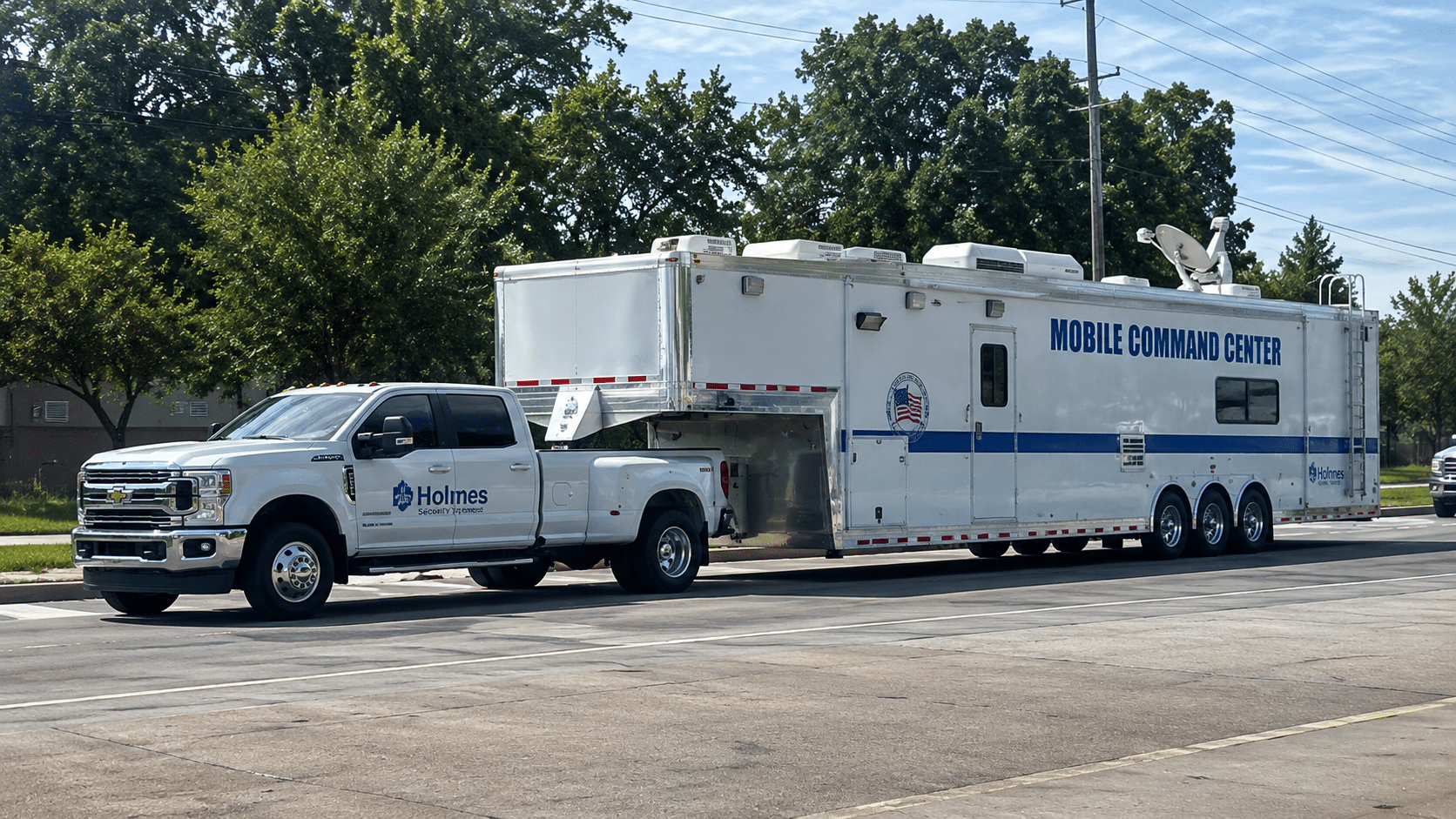
Mobile command center transport is the specialized hauling of command trailers and mobile operations units to emergency, disaster, and field sites nationwide. Interstate Haulers, a nationwide specialty transportation company, moves these assets safely across the continental United States—though it does not provide emergency management or command-center services itself.
When disaster strikes or a major operation gets underway, the mobile command center often becomes the nerve center for everything that follows. These rolling offices coordinate personnel, track resources, and keep communication flowing when regular infrastructure fails. But before any of that coordination can happen, the unit has to physically get to where it’s needed, often on short notice and across long distances.
That’s where mobile command center transport comes in. Interstate Haulers is a nationwide specialty transportation company that safely moves mobile command centers and operational trailers throughout the continental United States. The company has spent nearly 30 years hauling specialized equipment, and it’s been family-owned since 1997.
It’s worth being clear about scope here: Interstate Haulers transports these specialized assets—it does not provide emergency management, incident command, or command-center services. The agencies and organizations that own and operate the command centers handle that work. Interstate Haulers’ job is making sure the trailer shows up safely, on schedule, and ready to be put into service.
That distinction matters more than it might seem. A command center that arrives late, damaged, or improperly staged can delay an entire response effort. Dependable transportation isn’t a side detail in emergency operations—it’s part of what makes rapid response possible in the first place.
What Is a Mobile Command Center?
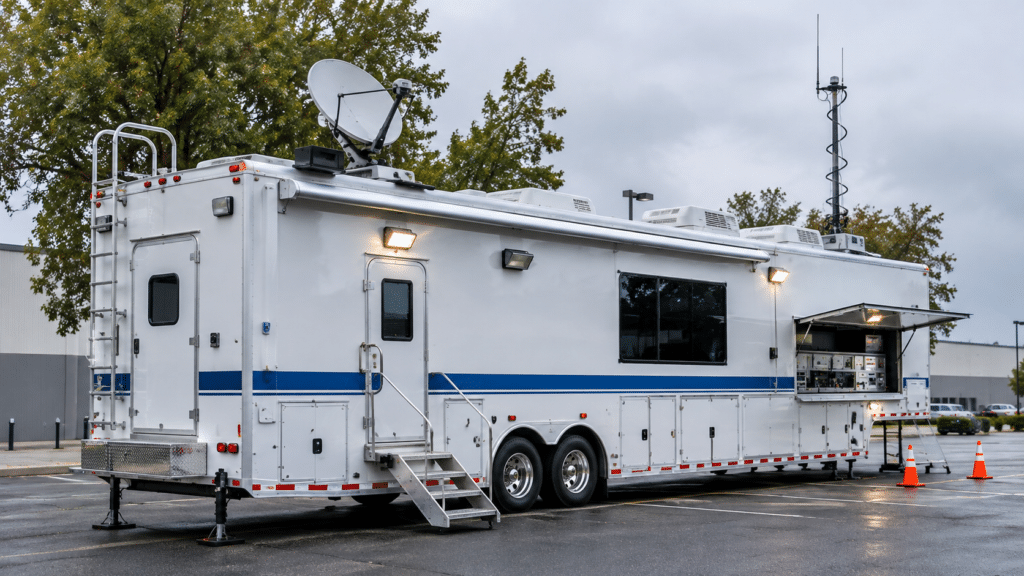
Mobile Command Center
A mobile command center is a self-contained unit, built on either a truck chassis or a trailer frame, that functions as a portable headquarters during emergencies, planned events, or extended field operations. According to the Federal Emergency Management Agency’s National Incident Management System (NIMS), effective incident response depends on shared systems and processes that allow different agencies to work together, and mobile command centers are often where that coordination physically happens.
Truck-based units are built directly onto a vehicle chassis, which allows them to be driven to a scene independently. Trailer-based command centers, by contrast, are towed into position and then set up as a stationary hub for the duration of the operation. Each configuration serves the same core purpose but suits different budgets, mission types, and jurisdictions.
A mobile command center typically functions as:
- A temporary office for incident commanders and support staff
- An operations hub for coordinating personnel and resources
- A communications center linking field teams with outside agencies
- Conference rooms, meeting and briefing space for multi-agency coordination
- A technology workspace for data, mapping, and video analysis
- An incident coordination center during the life of an event
Inside, these units are typically outfitted with multiple workstations, high-resolution display monitors, satellite communications, and rugged hardware built to withstand rough conditions. Onboard generators provide independent power, while climate control systems keep equipment and personnel functional in extreme weather. Many units also include secure communications, GIS mapping capability, live video feeds, documentation stations, and interoperable communication systems that let different agencies talk to each other on a shared network.
What Does a Mobile Command Center Actually Do During an Incident?
A mobile command center serves as a centralized workspace where multiple agencies can coordinate in real time. Rather than running an operation from scattered vehicles or borrowed office space, responders gain a single location for situational awareness, resource tracking, and communications.
During an active incident, a command center typically:
- Facilitates multi-agency coordination between police, fire, EMS, and other responders for solutions for disaster relief
- Provides real-time situational awareness through mapping and video feeds
- Coordinates personnel assignments across the response area
- Tracks equipment and resource allocation
- Supports communications between field teams and outside agencies
- Functions as a central office when permanent facilities are unavailable
- Maintains uninterrupted operations even when local power or infrastructure fails
That last point matters most during natural disasters, when the surrounding grid may be down for days. A well-equipped command center keeps running on its own generator power, which means the people inside it can keep making decisions regardless of what’s happening outside. This capability directly supports accountability, documentation, team coordination, and ultimately, mission success. When decision-makers have accurate, real-time information, they make better calls faster.
Which Industries Depend on Mobile Command Centers?
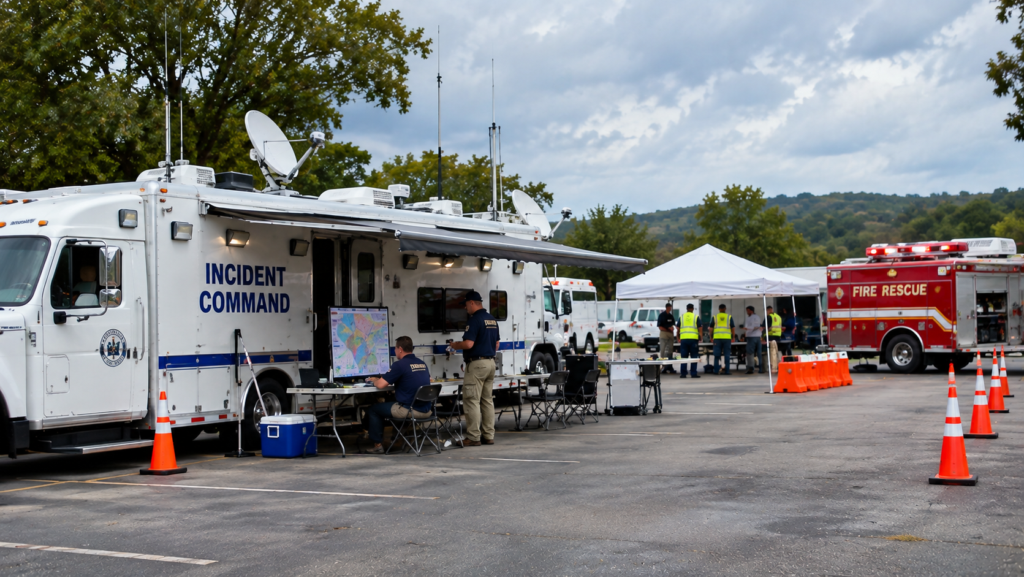
Mobile command centers show up across a wide range of fields, not just emergency services. Each industry uses them a little differently, but the underlying need—centralized coordination in the field—stays the same.
Law Enforcement
Police departments deploy mobile command centers for crime scenes, public safety incidents, crowd control at large events, and SWAT operations. Having a secure, mobile headquarters near the scene lets commanders manage evidence, personnel, and communications without relying on a fixed precinct location.
Fire & Rescue
Fire departments rely on command centers during wildfires, hazardous material incidents, search and rescue missions, and other large-scale emergency responses. These units let incident commanders track crew locations and coordinate with mutual aid partners from neighboring jurisdictions.
Emergency Management
Agencies like FEMA and local governments use mobile command centers for disaster recovery following hurricanes, floods, and tornadoes. The FEMA National Response Framework outlines how federal, state, and local resources coordinate during these events, and mobile command centers are frequently part of that coordinated response on the ground.
Utility Companies
Power and water utilities use mobile command centers to manage storm recovery and infrastructure emergencies. During extended outages, these units allow repair crews to coordinate from a central point close to the affected area rather than commuting back to a distant office.
Healthcare
Healthcare organizations use mobile command centers to support disaster medical response, temporary coordination hubs, and mobile clinics. In the aftermath of a major incident, these units can serve as a staging point for triage coordination and emergency healthcare delivery.
Military
Military units use mobile command centers for tactical command, intelligence coordination, and secure communications in the field. These applications often demand higher levels of hardening and security than civilian equivalents.
Corporate & Construction
Large infrastructure and construction projects sometimes use mobile command centers for remote job site coordination, security operations, and on-site communications support, particularly in locations without reliable existing infrastructure.
When Is Mobile Command Center Transport Needed?
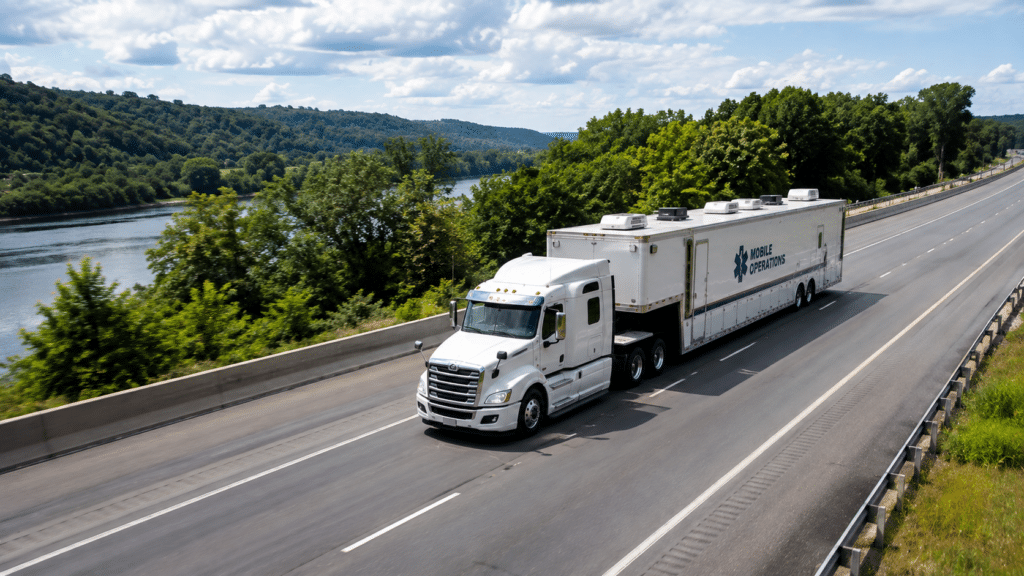
Mobile command center transport becomes essential any time a unit needs to move, whether that’s across the state or across the country. Common scenarios include:
Hurricanes
Pre-storm staging and post-storm recovery both require command centers to relocate quickly, often on compressed timelines as storm paths shift.
Wildfires
Fire response areas can change rapidly as conditions evolve, which means command units sometimes need to relocate multiple times during a single incident.
Tornado Recovery
Recovery efforts after a tornado often require a command center to arrive quickly to support search, rescue, and debris coordination.
Flood Response
Floodwaters can cut off typical transport routes, making experienced route planning essential for getting a command center into position.
Extended Power Outages
When outages stretch for days, utility crews and emergency managers rely on mobile command centers to keep operations running independent of the grid.
Search & Rescue Missions
Time-sensitive missions depend on a command center reaching a staging area as fast as possible.
Utility Restoration Projects
Large-scale restoration efforts after storms often require command units at multiple staging points as crews move through a service territory.
Planned Public Events
Large gatherings, from parades to sporting events, sometimes use mobile command centers for proactive security and coordination.
Remote Infrastructure Projects
Construction and infrastructure work in areas without existing facilities depends on mobile units being delivered to difficult-to-reach sites.
Disaster Recovery Operations
Long-term recovery efforts, which can run for weeks or months, often require multiple relocations as needs shift from immediate response to rebuilding.
Timing drives nearly every one of these scenarios. Early deployment gets a command center in place before crews arrive. Fast relocation accommodates mission changes as the response area shifts. And because emergencies are inherently unpredictable, the ability to respond rapidly to a changing situation is often what separates a smooth operation from a chaotic one.
Why Transportation Timing Can Make All the Difference
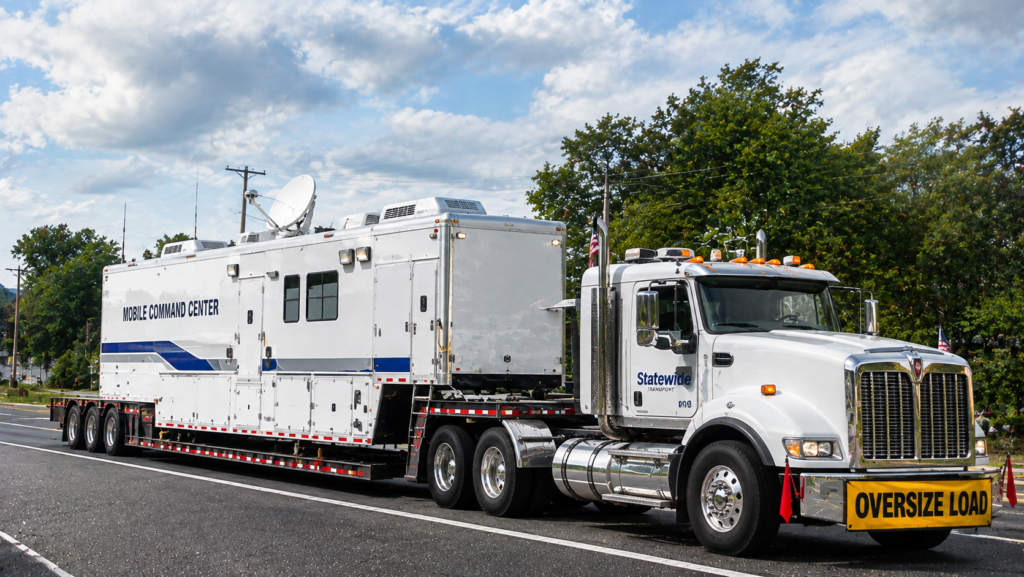
A command center is only useful once it’s in position and operational. If transportation lags behind the deployment schedule, everything downstream slows down, from staging to crew arrival to the start of operations.
Reliable transport means a command center arrives before crews need it, not after. It means staging locations are set up on schedule, and that relocating a trailer mid-operation doesn’t throw off the rest of the response. Cross-country transportation adds another layer of complexity, since weather, road conditions, and state regulations can all affect delivery timing along the route.
Clear communication between the hauler and the receiving personnel on-site matters just as much as the drive itself. When everyone knows the expected arrival window and any changes along the way, staging and setup go far more smoothly. Reliable transportation, in short, supports operational readiness from the moment the trailer leaves the yard to the moment it’s parked and ready to go.
What Factors Affect Mobile Command Center Transport?
Moving a mobile command center isn’t like hauling standard cargo. These units are often oversized, heavy, and loaded with sensitive equipment, which means transport planning has to account for several specific factors.
Trailer Length
Command trailers can run anywhere from a standard length up to 53 feet, which affects route selection and permitting requirements.
Overall Weight
Weight varies significantly depending on the vehicle platform and equipment installed, and it directly affects which roads and bridges a hauler can use.
Hitch Configuration
Bumper-pull, gooseneck, and fifth-wheel configurations each require different towing equipment and handling approaches.
Ground Clearance
Low ground clearance on some units can limit access to certain terrain or uneven staging areas.
Destination Accessibility
Not every command center ends up at a paved, easy-access site. Planning ahead for the actual destination terrain prevents delivery delays.
Rural & Remote Locations
Disaster response and infrastructure projects often place command centers in locations far from major highways, which requires careful route planning.
Staging Areas
Coordinating exactly where a unit will be positioned once it arrives helps avoid wasted time on-site.
Delivery Deadlines
Emergency situations often come with hard deadlines, and transport scheduling needs to build in a buffer for the unexpected.
State Regulations
Oversized loads are subject to a patchwork of state-by-state regulations, which experienced haulers need to navigate on multi-state routes.
Escort Requirements (When Applicable)
Depending on size and route, some loads require pilot vehicle escorts to travel legally and safely.
Route Planning
Good route planning accounts for road restrictions, weather, and real-time conditions, especially on long-haul or cross-country trips.
Experienced specialty haulers reduce the risk at every one of these decision points. Years of hands-on experience with oversized loads means fewer surprises along the route and a more predictable delivery timeline.
How Does Interstate Haulers Move Specialized Command Trailers Nationwide?
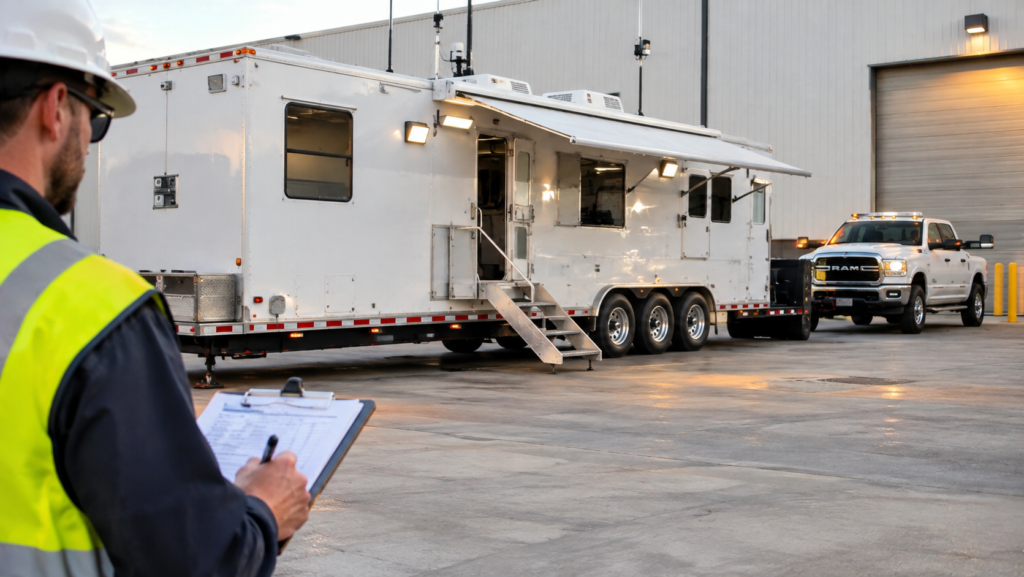
Interstate Haulers has been transporting specialty trailers since 1997, building nearly 30 years of experience moving oversized and specialized loads throughout the continental United States. As a family-owned company, Interstate Haulers emphasizes transparent communication and personalized service rather than treating every shipment as just another number on a dispatch board.
Interstate Haulers operates in compliance with Federal Motor Carrier Safety Administration (FMCSA) regulations, and its drivers bring hands-on experience handling oversized and specialty trailers. The company focuses on safe loading, secure transport, and professional delivery, with reliable scheduling that accounts for the time-sensitive nature of emergency deployments.
It bears repeating: Interstate Haulers transports command trailers. It does not operate, staff, or manage emergency operations. The agencies and companies that own these units handle all command and coordination functions once the trailer is on-site.
What Types of Mobile Command Centers Can Be Transported?
Interstate Haulers transports a wide range of mobile command and operations trailers, including:
- Police mobile command trailers
- Emergency operations trailers
- Communications trailers
- Utility operations trailers
- Incident command trailers
- Public safety command trailers
- Disaster response trailers
- Military communications trailers
- Mobile operations centers
- Field office trailers
- Construction command trailers
- Event operations trailers
Whatever the configuration, each of these units shares the same transport needs: safe loading, careful route planning, and on-time delivery.
Frequently Asked Questions
How much does a mobile command center cost?
Pricing varies widely depending on size, vehicle platform, technology, communications equipment, interior customization, generator systems, and other specialized features. Many units range from several hundred thousand dollars to over one million dollars depending on configuration.
What does a mobile command center do?
A mobile command center supports communication, coordination, resource management, situational awareness, operations planning, and emergency response. It functions as a centralized field command post during incidents, disasters, and large-scale events.
What is a mobile command police truck?
A mobile command police truck is a truck-based mobile command center used by law enforcement for crime scene management, public safety incidents, tactical operations, and incident coordination. Unlike trailer-based units, these are built directly onto a vehicle chassis for independent mobility.
Why do police use mobile command centers?
Police departments use mobile command centers to maintain secure communications, coordinate incidents, manage evidence, collaborate across multiple agencies, and oversee large public events or major investigations from a centralized, mobile location.
Why Do Organizations Trust Interstate Haulers?
Organizations that rely on mobile command centers need a transportation partner that understands the stakes. Interstate Haulers brings decades of specialty hauling experience, nationwide service coverage, and a family-owned approach to communication that keeps clients informed from pickup to delivery.
Safe transportation, reliable scheduling, and professional drivers with real experience moving oversized trailers all contribute to a transport process that agencies and companies can count on when timing matters most.
Getting Your Mobile Command Center Where It Needs to Be
Mobile command centers play an essential role in emergency response, disaster recovery, public safety, utility restoration, healthcare coordination, military operations, and large-scale field projects. But none of that coordination can happen until the unit physically arrives at its destination, on schedule and ready to go.
Interstate Haulers specializes in transporting mobile command trailers nationwide, backed by decades of specialty hauling experience, dependable communication, and safe transportation practices. Whether you’re deploying ahead of a hurricane, relocating a mobile command units unit mid-operation, or setting up for a planned event, reliable transport makes the difference between a command center that’s ready and one that’s still en route.
Request a quote from Interstate Haulers today to arrange transport for your mobile command center, operations trailer, emergency response trailer, or other specialized mobile unit anywhere in the continental United States.